


Episode: KPN 24-08-2026

“My baby was burned alive”: Nine years on, Rohingya survivors still carry the pain of 2017 Nine years after Myanmar military operations in Rakhine State drove hundreds of thousands of […]


 play_arrow
Episode: KPN 30-09-2026 Kaladan Podcast
 play_arrow
Episode: KPN 29-09-2026 Kaladan Podcast
 play_arrow
Episode: KPN 28-09-2026 Kaladan Podcast
 play_arrow
Episode: KPN 27-09-2026 Kaladan Podcast
 play_arrow
Episode: KPN 25-08-2026 Kaladan Podcast
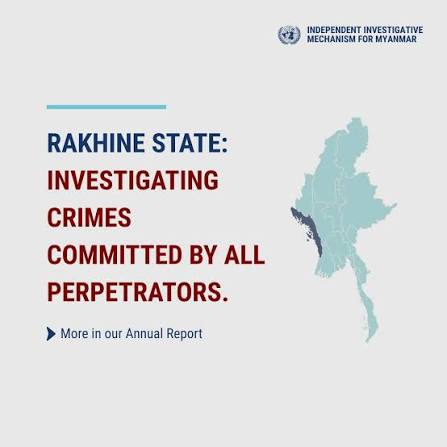
The United Nations’ Independent Investigative Mechanism for Myanmar (IIMM) has documented allegations of killings, sexual and gender-based violence, forced displacement, arbitrary detention and other serious abuses against Rohingya civilians amid escalating fighting between the Myanmar military and the Arakan Army (AA) in Rakhine State.
The findings are contained in the IIMM’s 2026 annual report, released on August 11, covering its investigative work from July 1, 2025, to June 30, 2026.
Allegations involve multiple armed actors
According to the report, alleged abuses in Rakhine State are not limited to the Myanmar military. The IIMM has also collected information concerning alleged violations by other armed actors, including the Arakan Army.
Allegations concerning the AA include killings, sexual and gender-based violence against Rohingya women, including rape, killings in Kyauktaw Township, and the recruitment of children under the age of 15.
The mechanism also documented allegations involving the destruction of Rohingya mosques and the subsequent use of mosque land for settlements occupied by non-Rohingya communities.
According to the report, such incidents increased significantly after 2024, when the AA intensified military offensives in Buthidaung and Maungdaw townships.
The IIMM further documented allegations that ethnic and religious slurs were used to collectively target Rohingya during incidents under investigation.
The mechanism also recorded the continued movement of Rohingya towards Bangladesh amid fighting, displacement and the clearing of Rohingya-populated areas in Rakhine State.
Myanmar military accused of continued attacks on civilians
At the same time, the IIMM documented allegations that the Myanmar military continued to carry out air and artillery strikes affecting civilians and civilian infrastructure.
The report says there has been a significant increase since 2025 in air and artillery attacks affecting civilians as well as schools, hospitals, markets and religious buildings.
The mechanism also recorded allegations of forced displacement involving Rakhine civilians in Sittwe Township, as well as detention and targeted attacks by military-affiliated armed groups against people held in displacement camps.
Restrictions on humanitarian access and deaths linked to food shortages were also documented.
Rakhine conflict deepens humanitarian crisis
The findings indicate that the conflict in Rakhine State extends beyond military confrontation between the Myanmar military and the AA and continues to fuel a wider humanitarian crisis affecting civilians’ lives, security, homes, livelihoods and property.
For the Rohingya, the crisis carries particular consequences.
Hundreds of thousands of Rohingya fled to Bangladesh following the Myanmar military’s 2017 crackdown. Many of those who remained in Rakhine State have since faced renewed displacement as fighting and insecurity spread across northern Rakhine.
The IIMM’s documentation now includes allegations involving sexual violence against Rohingya women, destruction of homes and religious buildings, displacement and interference with land and property.
These developments underscore that any future Rohingya return process involves not only physical security and the ability to return to places of origin, but also questions surrounding the restoration of homes, land, religious sites and other property.
Allegations are not judicial findings
The allegations concerning the Arakan Army contained in the IIMM report are based on information and evidence gathered during investigations. They should not be interpreted as final judicial findings or court judgments.
The IIMM was established by the United Nations to collect, preserve and analyse evidence of the most serious international crimes and violations of international law committed in Myanmar and to prepare material that can be shared with competent courts and other judicial authorities for possible future prosecutions.
By documenting allegations involving different armed actors, including the Myanmar military and the AA, the mechanism’s work focuses on identifying individuals responsible for serious crimes on the basis of evidence, regardless of their political or military affiliation.
For the Rohingya, the central challenge remains the creation of conditions that guarantee the right to life and security, voluntary and dignified return to their places of origin, and protection and restoration of housing, land and property rights.

“My baby was burned alive”: Nine years on, Rohingya survivors still carry the pain of 2017 Nine years after Myanmar military operations in Rakhine State drove hundreds of thousands of […]


