search menu
play_arrow

keyboard_arrow_right

skip_previous play_arrow skip_next
00:00 00:00
playlist_play chevron_left
volume_up
chevron_left
play_arrow

August 2026

Episode: KPN 24-08-2026

Kaladan Podcast August 24, 2026


Background
share close

Loading

“My baby was burned alive”: Nine years on, Rohingya survivors still carry the pain of 2017

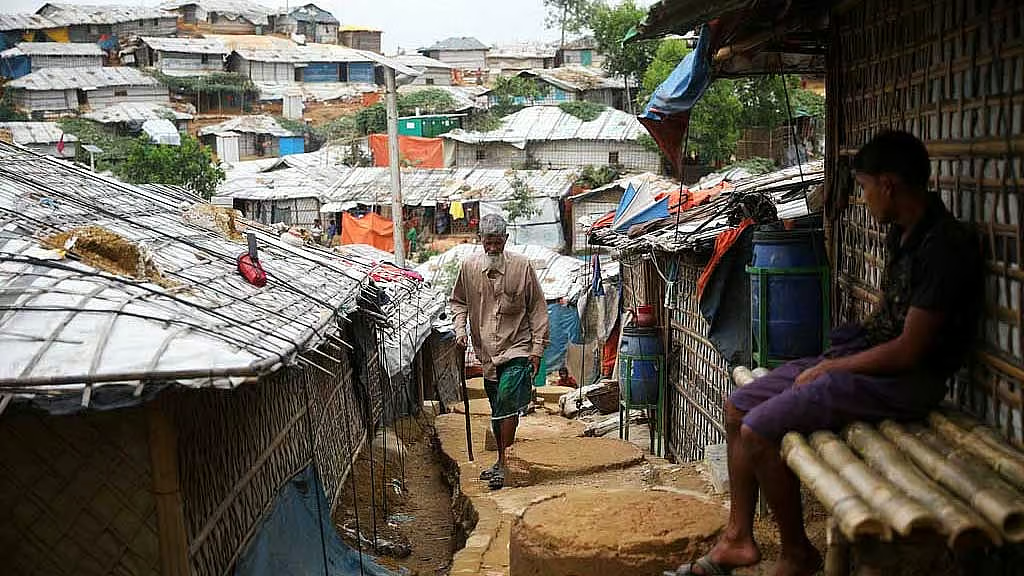
Nine years after Myanmar military operations in Rakhine State drove hundreds of thousands of Rohingya from their homes, survivors say the memories of killings, arson and violence remain painfully vivid, even as some begin new lives far from the refugee camps of Bangladesh.

Among them is Rokiyar Begum, a Rohingya survivor who has been resettled in Australia after spending years in Bangladesh. She recalled the events of August 30, 2017, in Tulatuli village, where she said soldiers seized her 18-month-old son, Mohammed Sadek, from her arms and threw him into a burning area.

“I was crying for my baby. They threatened to shoot me while I was crying,” Rokiyar Begum recalled.

Her testimony describes a day of extreme violence in which men and teenage boys were separated, shot and stabbed, while bodies were piled near a riverbank.

She also said women were forced into a burning building.

Shot Three Times, Saddam Hussein Survived

Another Rohingya survivor, Saddam Hussein, said he was shot three times in Mashfara village during the 2017 violence.

Seriously wounded and unable to move, he fled with his family toward Bangladesh by boat.

During the journey, he fell into the water as his condition deteriorated from blood loss.

“My body had turned pale from losing so much blood. My wife was pulling me with all her strength, but she could not move me,” Saddam Hussein recalled.

He said his condition became so severe that he told his wife to continue without him if he did not survive.

The following day, he was found by Bangladeshi border guards and two Rohingya men. He later received treatment and underwent surgery in hospitals.

Nine years later, the scars from the gunshot wounds remain on his body.

Seven Family Members Lost in Tulatuli

For Rokiyar Begum, the loss extended far beyond her infant son.

She said seven members of her family were killed during the violence in Tulatuli, including her mother and her 10-year-old brother.

Rokiyar, who was 21 at the time, said she escaped from a burning building through a back entrance before fleeing with other survivors toward the Naf River.

They later crossed by boat into Bangladesh.

More than 700,000 Rohingya fled to Bangladesh following the 2017 violence. Together with those who had escaped earlier waves of persecution, the Rohingya population seeking refuge in Bangladesh eventually exceeded one million.

From Refugee Camps to Australia

After spending about eight years in refugee camps in Bangladesh, Rokiyar Begum and Saddam Hussein were resettled in Australia in 2026 under humanitarian visas.

Their resettlement brought physical safety and the possibility of rebuilding their lives, but survivors say relocation has not erased the trauma of 2017.

For many Rohingya, the situation in their homeland also remains deeply uncertain.

Renewed conflict in Rakhine State has displaced civilians again, leaving Rohingya communities caught between armed actors.

Human rights expert Christopher Sidoti has said Rohingya civilians remain trapped amid fighting involving the Myanmar military and the Arakan Army.

Continuing Conflict Raises New Fears for Rohingya

The continuing violence in Rakhine State has reinforced concerns that Rohingya refugees cannot yet return safely and sustainably.

Communities that survived earlier military campaigns now face renewed displacement, insecurity and uncertainty over their future.

For survivors who fled in 2017, the continued instability adds another layer to the trauma of losing relatives, homes and livelihoods.

“We Want Justice”

International legal proceedings over alleged crimes against the Rohingya are continuing.

The Gambia has brought a case against Myanmar before the International Court of Justice (ICJ) concerning alleged violations of the Genocide Convention in relation to the Rohingya.

For Rokiyar Begum, the case represents a continuing hope that those responsible for the suffering of her family and community will one day face justice.

“I lost a lot of family members. When I heard that the lawsuits were moving forward, I felt hopeful,” she said.

Nine years after the violence, the events of 2017 are not simply history for survivors such as Rokiyar.

The family members she lost, the child she says was taken from her and killed, and the memories she carried from Rakhine State through the refugee camps of Bangladesh and eventually to Australia remain part of her life.

For Rohingya survivors, justice is not only about legal accountability. It is also about recognition of what happened, protection for those who remain at risk, and the possibility of a future in which they can live safely and with dignity.

Tagged as: , , , , , , , , , , , , , , , , , , , , , , , , , , , , , , , , , , , , , , , , , .

Download now: Episode: KPN 24-08-2026

file_download Download

Rate it
Previous episode