Episode: KPN 26-09-2026

Bangladesh plans high-level Rohingya event at 81st UN General Assembly Bangladesh plans to convene a high-level event on the Rohingya crisis during the 81st session of the United Nations General […]


 play_arrow
Episode: KPN 30-09-2026 Kaladan Podcast
 play_arrow
Episode: KPN 29-09-2026 Kaladan Podcast
 play_arrow
Episode: KPN 28-09-2026 Kaladan Podcast
 play_arrow
Episode: KPN 27-09-2026 Kaladan Podcast
play_arrow
Episode: KPN 27-09-2026 Kaladan Podcast
United Nations Secretary-General António Guterres used his final address to the UN General Assembly’s annual General Debate on Tuesday to frame many of the world’s most serious crises around a single question: power — who holds it, who is excluded from it, how it is exercised and how rapidly it is changing.
His message also captured a concern running through this year’s General Assembly: whether the United Nations and other institutions created after the Second World War remain equipped to respond to a world in which political, economic and technological power is increasingly fragmented.
“The faultlines in our world are widening,” Guterres told world leaders gathered for the 81st session of the General Assembly.
War, inequality, climate change and artificial intelligence, he argued, should not be understood simply as separate global emergencies.
“These are not separate crises,” he said. “They are chapters of the same story. The story of power.”
Three major shifts in global power
Guterres identified three fundamental changes.
First, power among states is shifting as new centres of economic, political and technological influence emerge.
Second, significant power is moving beyond governments and into the hands of a relatively small number of private corporations and individuals whose influence now reaches politics, economies, information, technology and civic life.
Third, humanity is transferring increasing power to machines as artificial intelligence advances and autonomous weapons move from theoretical possibility toward military reality.
For Guterres, these changes expose a fundamental weakness in the international system: institutions governing today’s world still largely reflect political and economic realities of an earlier era.
“Our institutions and systems of global governance continue to reflect the power realities and interests of a largely bygone age,” he said.
A recurring UNGA question: Can the UN adapt?
That concern has emerged as one of the important threads running through the 81st General Assembly.
The session itself is being held under the theme “Restoring trust, managing transformation: A United Nations that delivers for all.”
The wording is significant.
It reflects growing recognition among UN members that the institution is being asked to respond to wars, humanitarian emergencies, climate change, economic inequality and rapidly developing technologies while facing deep geopolitical divisions among its own member states.
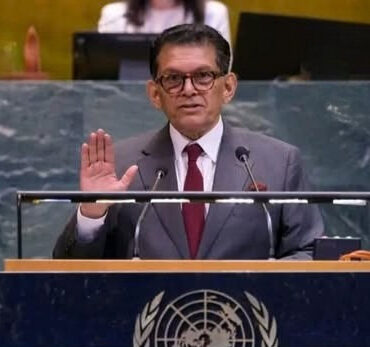
At the close of the six-day General Debate, General Assembly President Khalilur Rahman said world leaders had repeatedly raised the need for UN reform and stressed that administrative changes alone could not substitute for deeper political reform.
The debate therefore revealed something larger than criticism of whether the UN is “strong” or “weak.”
The underlying question is whether a multilateral institution established more than 80 years ago can adapt quickly enough to a radically different distribution of global power.
Four tests of power
Guterres organised his argument around four areas: war and peace, inequality, climate change and artificial intelligence.
On peace and security, he argued that international law must restrain the use of force.
That principle, he warned, is under profound pressure as conflicts continue across different regions.
Gaza was among the crises highlighted in his address, alongside broader instability in the Middle East.
But the General Assembly debate extended beyond Gaza. In his closing summary, General Assembly President Khalilur Rahman specifically referred to human suffering in Gaza, the plight of the Rohingya and continuing conflicts in Myanmar, Ukraine, Sudan and elsewhere.
For communities such as the Rohingya, this debate over international power is therefore not merely theoretical.
Their experience raises a practical question at the heart of the UN system: what happens when international institutions can document abuses, adopt resolutions and demand accountability, but political divisions prevent those demands from producing effective protection or durable solutions?
AI exposes a new struggle over who sets the rules
Artificial intelligence provided one of the clearest examples of competing visions of power during the General Assembly.
Guterres warned about the concentration of technological power and argued that AI must be governed before it begins governing critical aspects of human society.
Other leaders presented markedly different approaches.
U.S. President Donald Trump rejected attempts to create what he described as a global system for controlling AI and said the United States would promote the technology’s development while monitoring potential risks.
British Prime Minister Andy Burnham, by contrast, called for international cooperation toward common principles and standards for AI safety and transparency.
Those differences demonstrate the challenge confronting the UN: governments may agree that emerging technologies are transforming global power while disagreeing sharply over who should regulate them and how.
Inequality is also about power, Guterres argues
Guterres similarly presented global inequality as more than an economic problem.
Access to finance, opportunity, resources and representation determines which countries and communities have influence over decisions affecting their futures.
Developing countries have long demanded reforms to international financial institutions and greater representation in global decision-making bodies.
Calls for institutional reform were also prominent during this year’s General Debate.
General Assembly President Rahman said at its conclusion that Africa’s continued exclusion from permanent membership of the UN Security Council remained an unresolved issue in discussions over reform.
Climate change and the distribution of power
Climate change represented another dimension of Guterres’s argument.
The transition to renewable energy, in his view, has the potential not only to reduce emissions but also to redistribute geopolitical influence because renewable resources cannot be controlled in the same way as fossil-fuel supplies.
But climate policy remains another area where governments disagree substantially over responsibility, financing and the pace of transition.
Those divisions illustrate the broader problem identified throughout Guterres’s speech: global challenges increasingly require collective action at precisely the moment when geopolitical competition is making collective action more difficult.
The UN’s paradox: constrained but still indispensable
The General Assembly debate also highlighted a paradox surrounding the United Nations.
The organisation cannot independently force governments to end wars, accept political settlements or implement reforms. Its authority ultimately depends heavily on its member states — including major powers that frequently disagree with one another.
Yet the UN remains one of the few institutions capable of bringing almost every government into the same diplomatic arena.
This year’s General Debate included 194 delegations, according to the president of the General Assembly.
Speeches alone cannot resolve conflicts. Meetings on the sidelines cannot guarantee agreements.
But the gathering still allows adversaries to communicate, smaller states to put their concerns before a global audience, and disputes over international rules to take place within a common diplomatic framework.
For Rohingya people, whose future depends heavily on international diplomacy over Myanmar, accountability, humanitarian assistance and conditions for voluntary, safe and dignified return, the effectiveness of that system has direct consequences.
‘Power of law’ versus ‘law of power’
Guterres ended his address with perhaps the clearest summary of the argument he had made.
After a decade as UN secretary-general, he said humanity’s greatest power should not be understood as the ability to dominate others, but as the ability to build a future that works for everyone.
The future of the international system, he argued, will depend on whether governments can uphold international law, address inequality, confront climate change and establish effective governance for artificial intelligence.
His final appeal distilled the dilemma confronting the United Nations as it enters another period of geopolitical transformation:
“The power of law must prevail over the law of power.”
For the United Nations — and for vulnerable populations such as the Rohingya who depend on international rules for protection and accountability — whether governments are prepared to translate that principle into action remains the harder question.


Bangladesh plans high-level Rohingya event at 81st UN General Assembly Bangladesh plans to convene a high-level event on the Rohingya crisis during the 81st session of the United Nations General […]