



search menu
play_arrow

keyboard_arrow_right

skip_previous play_arrow skip_next
00:00 00:00
playlist_play chevron_left
volume_up
chevron_left
play_arrow

August 2026

Episode: KPN 08-08-2026

Kaladan Podcast August 8, 2026


Background
share close

Loading

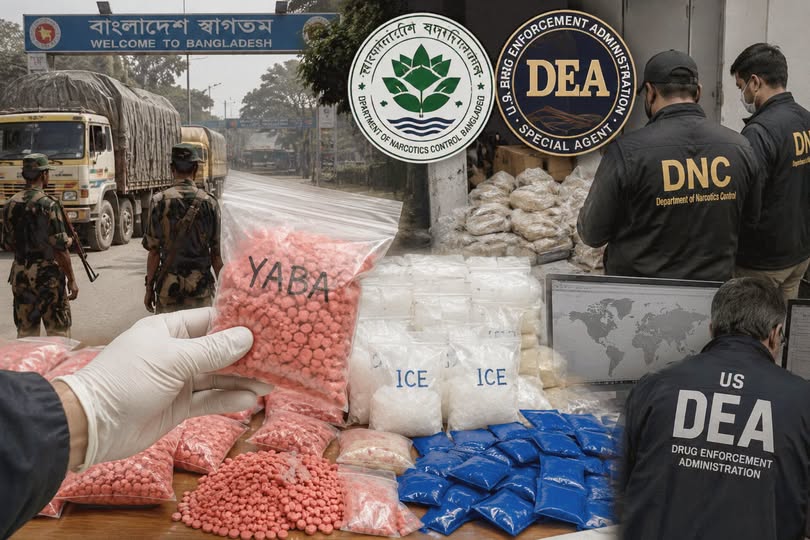
Yaba, Crystal Meth used as ‘Narco-Currency’ in cross-border trade with Myanmar, officials say

Yaba and crystal meth are increasingly being used as a form of “narco-currency” in illicit cross-border trade between Bangladesh and conflict-hit Rakhine State, with Bangladeshi goods allegedly exchanged for drugs through maritime trafficking networks, according to officials and sources familiar with the trade.

Bangladeshi smugglers have long supplied construction materials, fuel and food to armed groups and markets inside Myanmar, but sources say cash is no longer the only means of payment. Officials allege that Myanmar armed groups, including the Arakan Army, are increasingly settling part of the value of smuggled Bangladeshi goods with yaba and crystal meth.

The allegations are based on Bangladeshi narcotics officials, police and sources familiar with trafficking networks and have not been independently verified inside Myanmar.

Fishing Boats Carry Goods Out, Drugs Back

According to the source material, fishing boats transport Bangladeshi commodities across the Bay of Bengal and return carrying narcotics.

One reported route begins at Ayeik Sit jetty in Myanmar’s Ayeyarwady Region, where drugs are packed onto fishing boats before being moved into the Bay of Bengal. Another route reportedly runs from Yangon through Minbya, Ann, areas near Sittwe, Rathedaung and Maungdaw before approaching the Bangladesh frontier.

Sources said Myanmar-side carriers sometimes use satellite communication devices to contact Bangladeshi receivers before completing handovers at sea, after which consignments enter Bangladesh through different points along the Naf River.

DNC Confirms Drugs-for-Goods Pattern

Somen Mondol, deputy director of the Department of Narcotics Control in Cox’s Bazar, said daily essentials were being smuggled from Bangladesh while yaba was brought back in exchange.

“In many cases, fishing boats cross the border with goods. Later, while returning, they bring yaba in the same boats,” he said.

Mondol said hundi networks had long been used to settle illegal transactions, but the system had evolved to include direct exchanges involving goods and narcotics.

He also alleged that some Rohingya individuals were involved alongside local groups. That claim is attributed to the DNC official and should not be interpreted as implicating the wider Rohingya community.

Rakhine Shortages Increase Demand for Bangladeshi Goods

The trade has reportedly expanded as fighting in Rakhine State disrupts normal supply chains.

According to officials cited in the report, the flow of yaba from Myanmar increased after the Arakan Army gained control over large stretches of the border. The source material says fighting intensified from November 2023 and that military supply restrictions later contributed to shortages of food, fuel and construction materials.

A senior Bangladeshi police official monitoring the Myanmar border alleged that these shortages had increased reliance on supplies from Bangladesh and that drugs were sometimes offered in exchange.

Yaba Seizures Rose Sharply in 2025

The DNC’s Annual Drug Report Bangladesh 2025 also records a major increase in seizures of amphetamine-type stimulants.

Bangladeshi law enforcement agencies seized 43,562,811 ATS tablets in 2025, up 90.58 percent from 22,857,751 in 2024. In 2023, seizures stood at 42,977,219 tablets.

DNC Director General Md Hasan Maruf linked the growing supply to what he described as Myanmar armed groups’ use of yaba as “narco-currency.”

Source Describes Wholesale Yaba and Ice Prices

A source familiar with the trade provided a wholesale price list for yaba and crystal meth.

According to the list, different yaba brands reportedly sell at varying wholesale prices, while crystal meth, locally known as “ice,” was priced at about Tk 450,000 per kilogram for higher-quality products and Tk 350,000 for lower-grade varieties.

The figures illustrate the commercial scale of the illicit trade, though KPN has not independently verified the price list.

Fisherman Describes Alleged Smuggling Operation

The report also cites a fisherman who said he had worked aboard a vessel involved in moving commodities from Bangladesh to Myanmar and returning with yaba.

He alleged that daily goods including cement, rice, lentils and edible oil were transported several times a month, while drugs were concealed in fish on return journeys.

A boat owner identified in the report denied involvement in illegal trade, saying he had rented out his vessel and later reclaimed it after learning of suspected illicit activity.

Most Yaba and Crystal Meth Consumed in Bangladesh

Officials said almost all yaba and crystal meth entering Bangladesh originated in Myanmar, with an estimated 80 to 90 percent consumed domestically.

Only smaller quantities are reportedly moved onward through air passengers or courier parcels to countries in the Middle East, Europe, the United States and Australia.

Officials said tighter airport scanning and CCTV surveillance had made overseas trafficking more difficult.

Traffickers Shift Routes When Surveillance Tightens

Border Guard Bangladesh’s 64 Battalion, which guards important sections of the Naf River around Ukhiya and Teknaf, said trafficking networks frequently shift routes when enforcement pressure increases.

Lt Col Md Zahirul Islam said smugglers move to alternative border points or maritime channels when one area comes under tighter surveillance.

The BGB has previously alleged that the Arakan Army was directly involved in yaba trafficking and that smuggling had increased through remote areas of Naikhongchhari in Bandarban.

That allegation remains attributed to Bangladeshi authorities.

Navy Seizes Cement and Other Goods Bound for Myanmar

Recent Bangladesh Navy operations also illustrate the scale of the outward flow of commodities.

On June 26, naval personnel reportedly detained 21 suspected smugglers and seized two fishing boats carrying 1,450 sacks of cement in the Bay of Bengal.

Earlier, on June 2, another operation near Saint Martin’s Island resulted in 20 arrests and the seizure of 1,700 sacks of cement allegedly bound for Rakhine State.

Other operations recovered cement, diesel, pulses, ginger and energy drinks allegedly being trafficked toward Myanmar.

Conflict Economy Drives Cross-Border Smuggling

Officials said persistent shortages inside Rakhine have dramatically increased the value of Bangladeshi goods.

A bag of cement worth around Tk 500 in Bangladesh can reportedly sell for as much as 100,000 Myanmar kyats in conflict-affected areas, creating large profit incentives for smugglers.

The trade therefore appears to operate as a two-way illicit economy: essential goods move from Bangladesh toward Rakhine, while narcotics flow back toward Bangladesh.

Similar Commodity-for-Drug Exchanges Reported on India Border

The use of narcotics as a form of payment is not confined to the Myanmar frontier.

Bangladeshi officials and former law-enforcement personnel cited in the report said similar settlement methods operate along the India border, where Phensedyl, cannabis and heroin may be exchanged for commodities alongside hundi transactions.

Payments may also involve cash carriers, mobile financial services, gold, hilsa and other contraband, with values offset against narcotics consignments.

Conflict, Scarcity and Drugs Become Interconnected

The emerging pattern shows how armed conflict, shortages and illicit commerce are becoming increasingly intertwined across the Bangladesh-Myanmar frontier.

For Bangladesh, the challenge extends beyond conventional drug smuggling. Traffickers are combining maritime routes, informal money-transfer systems, commodity shortages and conflict economies to sustain increasingly flexible cross-border networks.

The growing use of yaba and crystal meth as a medium of exchange also complicates enforcement because narcotics are no longer only final commodities for sale but can function as settlement instruments within broader trafficking arrangements.

Editor’s Note: Allegations concerning the involvement of the Arakan Army, Rohingya individuals and other actors are attributed to Bangladeshi officials and anonymous sources cited in the source report. KPN has not independently verified those allegations inside Myanmar.

Tagged as: , , , , , , , , , , , , , , , , , , , , , , , , , , , , , , , , , , , , , , , , , .

Download now: Episode: KPN 08-08-2026

file_download Download

Rate it
Previous episode