

Episode: KPN 18-09-2026

Malaysia PM plans to invite Min Aung Hlaing for talks on Rohingya Refugee return Malaysian Prime Minister Anwar Ibrahim said he plans to invite Myanmar President Min Aung Hlaing for […]


 play_arrow
Episode: KPN 31-10-2026 Kaladan Podcast
 play_arrow
Episode: KPN 30-10-2026 Kaladan Podcast
 play_arrow
Episode: KPN 29-10-2026 Kaladan Podcast
 play_arrow
Episode: KPN 28-10-2026 Kaladan Podcast
 play_arrow
Episode: KPN 19-09-2026 Kaladan Podcast
Dengue has killed six Rohingya refugees and infected more than 2,500 people in the refugee camps of Cox’s Bazar this year, with health officials reporting continued transmission even as the monsoon season approaches its end.
According to figures from health authorities, 2,507 dengue infections and 2,505 hospital admissions were recorded among Rohingya refugees between January 1 and August 29. Six refugees died from the mosquito-borne disease during the period.
Five of the patients died while receiving treatment at health facilities serving the camps, while another died at Cox’s Bazar Sadar Hospital.
135 new cases detected in camps in one week
Dr Abu Toha Md Rezwanul Haque Bhuiyan, chief health coordinator at the Office of the Refugee Relief and Repatriation Commissioner (RRRC), said another 135 dengue cases had been detected in the camps during the latest reporting week.
Health data showed that several camps were experiencing comparatively high infection rates relative to their populations.
Nayapara Registered Camp recorded the highest rate at 1.61 percent, followed by Camp 14 at 0.81 percent, Camp 26 at 0.34 percent, Camp 19 at 0.31 percent, and Camp 4 Extension at 0.12 percent.
Overcrowding, inadequate drainage and stagnant water accumulated during the monsoon are creating favourable breeding conditions for Aedes mosquitoes, which transmit dengue, according to health officials.
Dengue spreads across Cox’s Bazar district
The dengue outbreak is not confined to the Rohingya camps.
According to the Cox’s Bazar Civil Surgeon’s Office, the district recorded 3,856 dengue cases and 3,660 hospital admissions between January 1 and September 13.
Thirty-five dengue patients remained hospitalized when the report was issued, including 22 receiving treatment at Cox’s Bazar Sadar Hospital. Other patients were being treated in facilities in Maheshkhali, Teknaf, Chakaria, Ukhiya and Pekua.
Among local areas, Teknaf recorded the highest cumulative number with 332 identified cases, followed by Maheshkhali with 268, Chakaria with 261 and Ukhiya with 195.
Cox’s Bazar Sadar recorded 95 cases, Eidgah 58, Ramu 53, Pekua 14 and Kutubdia 13. Another 17 cases were recorded in municipal areas and 43 elsewhere.
Teknaf records sharp concentration of new infections
Health data also indicated a concentration of recent infections in Teknaf.
The September 13 report recorded 40 new locally detected infections, with Teknaf accounting for 33 cases. New cases were also reported in Maheshkhali, Chakaria, Ramu, Ukhiya, Eidgah and Cox’s Bazar Sadar.
The continued transmission comes as dengue infections rise across Bangladesh. By September 13, the country had recorded more than 51,000 dengue cases and 149 deaths during 2026, according to the Directorate General of Health Services.
The Institute of Epidemiology, Disease Control and Research (IEDCR) has also warned that dengue transmission could remain high for several weeks, identifying Cox’s Bazar among districts where the situation could worsen.
Crowded camp conditions complicate dengue control
The densely populated Rohingya camps present particular challenges for controlling mosquito-borne diseases.
Health officials have pointed to overcrowding, limited drainage and standing water as conditions that allow mosquito breeding sites to develop during the rainy season.
Although the monsoon is nearing its end, the detection of another 135 infections during the latest reporting week indicates that dengue transmission inside the camps remains active.
The six deaths and more than 2,500 recorded infections underline the continuing public-health risks facing Rohingya refugees living in densely populated settlements in Cox’s Bazar.
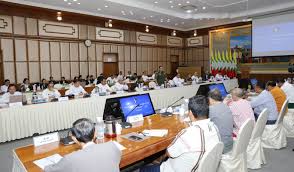


Malaysia PM plans to invite Min Aung Hlaing for talks on Rohingya Refugee return Malaysian Prime Minister Anwar Ibrahim said he plans to invite Myanmar President Min Aung Hlaing for […]