

Episode: KPN 11-02-2025

Shiv Sena (UBT) seeks deportation of Bangladeshis, Rohingyas on US pattern The Shiv Sena held a protest demonstration in Jammu on Friday, asking the Centre to draw inspiration from the […]


 play_arrow
Episode: KPN 30-09-2026 Kaladan Podcast
 play_arrow
Episode: KPN 29-09-2026 Kaladan Podcast
 play_arrow
Episode: KPN 28-09-2026 Kaladan Podcast
 play_arrow
Episode: KPN 27-09-2026 Kaladan Podcast
 play_arrow
Episode: KPN 12-02-2025 Kaladan Podcast
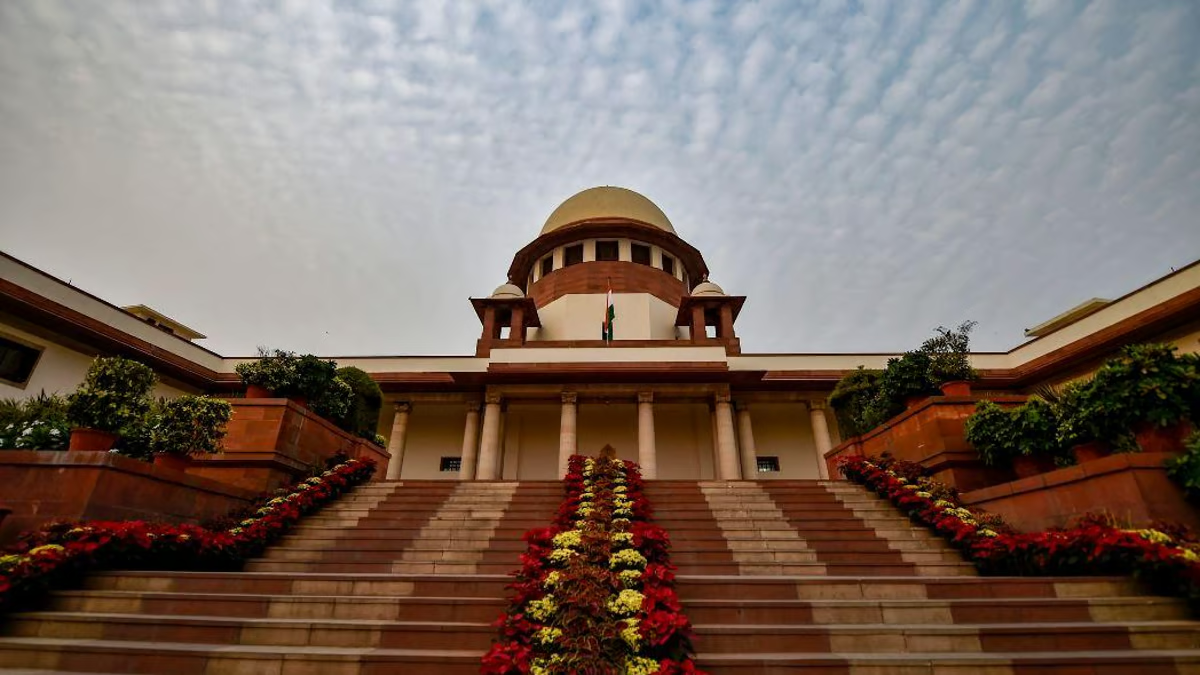
The Supreme Court (SC), today, February 12, reiterated that education must be provided to all children without discrimination, but emphasised the need to first ascertain the residential status of Rohingya refugee families before deciding on their eligibility for school admissions and government benefits.
A bench comprising Justices Surya Kant and N Kotiswar Singh was hearing a public interest litigation (PIL) seeking directives to grant Rohingya refugee children access to school admissions and government welfare schemes without requiring Aadhaar cards or citizenship proof, said a report by LiveLaw.in.
During a previous hearing, the Supreme Court had asked the petitioners to furnish specific details about the residential status of Rohingya families, stating that their right to education would stem from their living conditions.
The court had also noted that the mode of providing education might vary depending on whether the families were living in designated camps or regular residential areas.
‘Education is a right, but implementation must be assessed’
Referring to past cases, Senior Advocate Colin Gonsalves, representing the petitioners, highlighted that the union government had previously affirmed that Rohingya refugees could access public schools and hospitals. He pointed out that Solicitor General Tushar Mehta had assured the court that there would be no discrimination in granting them basic rights.
Justice Kant agreed, emphasising that education must be available to every child without bias. However, he stressed the need to verify where and how these families are living before determining the best approach to ensure their education.
“In terms of education, there is no question of discrimination. Every child will get admission. But we first need to establish where they are living, under what circumstances, and the most effective way to provide them education,” Justice Kant said.
In a separate but related petition, the Supreme Court has asked another petitioner — a non-governmental organisation (NGO) advocating for Rohingya refugee children’s education — to submit an affidavit detailing whether the refugees are living in temporary camps or settled residential colonies, added LiveLaw.in.



Shiv Sena (UBT) seeks deportation of Bangladeshis, Rohingyas on US pattern The Shiv Sena held a protest demonstration in Jammu on Friday, asking the Centre to draw inspiration from the […]


