

Episode: KPN 17-10-2026

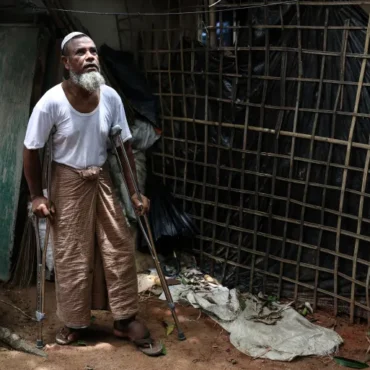
AA reportedly orders Rohingya residents to leave Ah Nauk Pyin village by October 17 The Arakan Army (AA) has reportedly ordered Rohingya residents of Ah Nauk Pyin village in Rathedaung […]


 play_arrow
Episode: KPN 25-10-2026 Kaladan Podcast
 play_arrow
Episode: KPN 24-10-2026 Kaladan Podcast
 play_arrow
Episode: KPN 23-10-2026 Kaladan Podcast
 play_arrow
Episode: KPN 22-10-2026 Kaladan Podcast
 play_arrow
Episode: KPN 18-10-2026 Kaladan Podcast
Access to accurate and reliable information is becoming increasingly important as artificial intelligence, online disinformation, internet shutdowns and weaknesses in transparency systems make it harder for people to determine what is true and hold authorities accountable, according to data and arguments presented in a commentary marking World News Day and the International Day for Universal Access to Information.
The commentary, titled “The Integrity Dividend: The Value of Knowing,” argues that the unprecedented volume of information available to the public has not necessarily made societies better informed.
Instead, rapidly spreading misinformation, algorithms that can reward inflammatory content, synthetic material generated by artificial intelligence and restrictions on access to information are creating new challenges for citizens, journalists and public institutions.
The article points to findings from UNESCO and digital rights organisations showing a continuing gap between formal guarantees of access to information and the public’s practical ability to obtain reliable records.
It argues that independent journalism remains essential in closing that gap by investigating, verifying and contextualising information for the public.
Record number of internet shutdowns reported in 2025
The commentary cites Access Now and the #KeepItOn coalition as documenting 313 internet shutdowns across 52 countries in 2025, which it described as the highest number recorded.
Internet shutdowns can prevent journalists from reporting, restrict communication among affected communities and block access to potentially life-saving information during crises, the article said.
Such restrictions have broader implications for accountability because people cannot effectively scrutinise authorities or document events when communication networks are unavailable.
For communities affected by conflict, displacement or humanitarian emergencies, access to timely and independently verified information can be particularly important.
141 countries have legal guarantees for access to information
The commentary cites UNESCO’s 2025 monitoring as showing that 141 countries had legal guarantees for access to information.
However, it stresses that adopting legislation does not necessarily mean people can effectively exercise those rights.
Practical shortcomings remain in areas including oversight, appeals, enforcement, record-keeping and data management, according to the article.
Among countries covered by UNESCO’s survey, 51 reportedly could not provide record-keeping data despite saying they had relevant systems or procedures in place.
The findings illustrate the difference between establishing a legal right to information and ensuring that government institutions can actually deliver information when requested.
Information oversight bodies face pressure
The commentary also highlights the role of information commissioners and other independent oversight institutions responsible for implementing access-to-information laws.
It says such bodies can be weakened by inadequate legal mandates, delayed appointments, funding reductions, political interference, restrictions on their powers and challenges to their independence.
Effective information-access systems therefore require more than legislation, the article argues.
Oversight institutions also need sufficient authority, resources and independence to enforce the rights established under national law.
Test found 38% of information requests received no substantive response
A 2025 exercise conducted jointly by UNESCO and the Centre for Law and Democracy further illustrated implementation problems, according to the commentary.
The organisations reportedly submitted 146 identical access-to-information requests across 76 countries.
The article says:
A similar exercise was expected to be conducted again in 2026 to measure whether performance had changed.
The findings suggest that the existence of access-to-information legislation does not automatically guarantee timely or complete disclosure.
Independent journalism remains critical in information vacuum
The commentary argues that independent journalism becomes particularly important when official information is incomplete, inaccessible or contested.
Journalists do more than transmit information, it says. Their role includes investigating claims, questioning decision-makers, corroborating evidence, providing context and challenging disinformation.
These functions are increasingly important in an online environment where false or manipulated material can spread rapidly before journalists or fact-checkers have had time to verify it.
For conflict-affected and displaced communities, inaccurate information can also carry immediate consequences, particularly when rumours or manipulated content concern security, humanitarian assistance, refugee policy or relations between ethnic and religious communities.
AI adds new dimension to disinformation challenge
Artificial intelligence has further complicated the information environment by making realistic-looking synthetic content easier and faster to produce.
The commentary warns that AI can generate plausible falsehoods at scale, adding to existing problems involving manipulated images, videos, statistics and social media narratives.
It cites a UNESCO estimate that individual cases of disinformation can generate substantial economic and social costs through effects on public health, elections, climate policy, financial activity, institutional reputations and public trust.
The article consequently describes disinformation not merely as a communications issue but as a governance and economic risk that can undermine people’s ability to make informed decisions.
The precise methodology and scope behind the cited monetary estimate would need to be consulted in the underlying UNESCO material before treating the figure as a universally applicable measure of disinformation costs.
Public-interest media face multiple pressures
The commentary identifies public-service broadcasters and independent news organisations as important counterweights to false and manipulated information.
At the same time, it says news organisations are confronting fragmented audiences, declining public trust, political interference, financial constraints, dependence on digital platforms and increasing volumes of synthetic or manipulated content.
Those pressures can weaken the ability of newsrooms to undertake costly reporting, verification and investigative work.
The article therefore calls for renewed investment in public-interest journalism, editorial independence, fact-checking, open-source verification and media and information literacy.
It also advocates greater cross-border cooperation among journalists and media organisations because disinformation itself can circulate internationally.
‘Rigour over reach’
The commentary concludes by assigning responsibility across governments, technology platforms, media organisations and the wider public.
Governments, it argues, should effectively enforce access-to-information laws and protect independent oversight institutions.
Technology companies and online platforms should accept responsibility for the information environments their systems create while operating consistently with international human rights standards.
For news organisations, its message is particularly direct: journalism should choose “rigour over reach.”
That principle has increasing significance in a digital environment where speed, virality and engagement can reward information before its accuracy has been established.
For independent media serving communities affected by conflict and displacement, credibility depends on maintaining a clear distinction between verified facts, official claims, eyewitness accounts, allegations and information that remains unconfirmed.
Access to information alone does not guarantee an informed society. The value emerges when information can be obtained, independently verified, placed in context and made available without political or technological manipulation.
In an information environment increasingly shaped by artificial intelligence and social media algorithms, the ability to answer basic questions — what happened, who is responsible, and what evidence supports the claim — remains fundamental to credible journalism and public accountability.


AA reportedly orders Rohingya residents to leave Ah Nauk Pyin village by October 17 The Arakan Army (AA) has reportedly ordered Rohingya residents of Ah Nauk Pyin village in Rathedaung […]