Episode: KPN 09-11-2026

UN envoy, Bangladesh home minister discuss safe and voluntary Rohingya repatriation United Nations Special Envoy on Myanmar Julie Bishop and Bangladesh Home Minister Salahuddin Ahmed have discussed the Rohingya crisis […]


 play_arrow
Episode: KPN 15-11-2026 Kaladan Podcast
 play_arrow
Episode: KPN 14-11-2026 Kaladan Podcast
 play_arrow
Episode: KPN 13-11-2026 Kaladan Podcast
 play_arrow
Episode: KPN 12-11-2026 Kaladan Podcast
 play_arrow
Episode: KPN 10-11-2026 Kaladan Podcast
The Arakan Army (AA) is preparing a plan to relocate residents from several remote villages along the Bangladesh–Myanmar border to more accessible areas of Maungdaw District, citing security concerns amid continuing armed conflict and instability in northern Arakan State.
The proposed relocation comes as the AA is engaged in fighting with the Myanmar military and faces continuing security challenges involving the Arakan Rohingya Salvation Army (ARSA) in areas near the border.
Under the plan, residents of selected remote villages would be moved to locations with better road and river connections, where the AA says security and administrative oversight can be more effectively maintained.
AA Chief Cites Security Concerns
AA commander-in-chief Twan Mrat Naing said in a March 2 interview that the relocation plan would primarily affect isolated border villages, including settlements inhabited by members of the Mro community.
“Many villages are isolated and scattered. We will have to ensure that this isolation comes to an end,” he said. “We will have to relocate them and move them to a place where we can provide security and keep an eye on them.”
The AA chief did not provide a timetable or detailed implementation plan.
The Bangladesh–Myanmar border stretches approximately 271 kilometres, including a 64-kilometre river boundary along the Naf River. On the Myanmar side, the frontier passes through Maungdaw in Arakan State and Paletwa in Chin State, opposite Bangladesh’s Cox’s Bazar and adjoining border areas.
Both Maungdaw and Paletwa are currently under AA control. The proposed relocation, however, is focused on villages in the Maungdaw border area.
Northern Maungdaw has historically had a predominantly Rohingya Muslim population. Many Rohingya settlements were destroyed or abandoned during the Myanmar military’s 2017 operations, which forced more than 700,000 Rohingya to flee to Bangladesh.
Numerous villages along the frontier are also inhabited by Rakhine, Mro, Khami, Chakma and other communities.
ARSA Activity Raises Border Security Concerns
The AA has yet to establish complete security control along parts of the Bangladesh–Myanmar frontier, where armed groups continue to operate.
ARSA, a Rohingya armed group, has periodically clashed with the AA and has been accused of attacks, abductions and killings involving residents of villages near the border and the Mayu mountain range.
ARSA carried out attacks against Myanmar police and security posts in 2016 and 2017. The Myanmar military subsequently launched what it called “clearance operations,” during which thousands of Rohingya were killed and more than 700,000 fled across the border into Bangladesh.
The security situation changed again during the AA’s offensive in late 2023 and 2024. Rohingya armed groups, including ARSA and the Rohingya Solidarity Organisation (RSO), became involved in fighting alongside or in coordination with Myanmar military forces in some areas, according to multiple reports and accounts from the conflict.
Despite resistance, the AA eventually captured Maungdaw.
ARSA members are reported to remain active in parts of northern Maungdaw and the Mayu mountain range, which extends through Buthidaung, Maungdaw and Rathedaung townships.
Residents and local sources have accused the group of abducting and killing members of Rakhine, Mro, Khami, Thet and Chakma communities.
On November 12 last year, three people, including a 10-year-old girl, were reportedly abducted and killed after leaving Kone Chaung village in Maungdaw.
“They were in a group of six people. Three men managed to escape with injuries,” Soe May, whose daughter was killed, said in an interview with The Diplomat.
AA Faces Pressure on Multiple Fronts
The relocation proposal comes as the AA continues fighting Myanmar military forces around Sittwe and surrounding areas.
Myanmar military forces have launched a renewed offensive, referred to as “Operation 4926,” in an effort to retake territory lost to the AA in Arakan State.
AA and United League of Arakan (ULA) officials interviewed for the original report expressed concern that the Myanmar military could provide weapons or other assistance to ARSA to intensify attacks against the AA in northern Arakan.
Such claims could not be independently verified.
A senior ULA official identified around 20 villages between border pillars 50 and 57 as particularly vulnerable to attacks. Many of the settlements are inhabited by Mro and Rakhine communities.
Residents of border villages also depend heavily on access to Bangladesh for essential commodities, trade and medical treatment. Increased armed activity could further restrict those movements.
Traders from Maungdaw who regularly travel near the frontier have claimed that ARSA and RSO maintain camps on the Bangladesh side of the border, including in Bandarban in the Chittagong Hill Tracts.
“Some of these camps are not far from the outposts established by the Bangladesh Border Battalion. The border around Tombru in Bangladesh is the area where the ARSA is most active,” said Kyaw Aye Than, a trader from Waylartaung village.
KPN could not independently verify the reported locations of the alleged camps.
Military Commitments Stretch AA Resources
The AA has deployed substantial forces in its campaign against the Myanmar military around Sittwe and elsewhere in Arakan State.
AA personnel are also operating alongside local People’s Defence Forces (PDFs) in areas including Sagaing, Magway and Ayeyarwady.
Opening another sustained front against ARSA along the Bangladesh border could further stretch AA manpower and resources.
The AA recently launched a second compulsory recruitment drive under what it calls the National Emergency Defense Provision as it seeks to increase its forces.
Twan Mrat Naing also said the AA had received information suggesting links between ARSA and individuals in some non-Rohingya villages. Such cooperation, if confirmed, could involve information sharing and create additional security challenges for the AA.
Alongside relocation, the AA is considering greater use of surveillance technology—including drones, cameras and other equipment—to monitor border areas, according to the AA chief.
Border Families Already Moving
Some families from non-Rohingya communities have already begun leaving villages near the frontier for settlements farther inside Maungdaw.
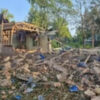
On February 10, four huts were reportedly under construction near Kine Gree village, around 20 kilometres north of Maungdaw town. The families, members of the Mro community, had moved from Don Nyou village near border pillar 52.
Kaing Htauk, an elderly resident involved in building the houses, said 85 households from Pyar Re and Kyauk Lone villages near border pillars 55 to 58 had begun relocating since last year.
The families are constructing homes on land allocated by the ULA, he said.
“ARSA camps and training facilities across the border in Bangladesh are not very far from our village,” Kaing Htauk said. “We were told by ARSA functionaries to join hands with them. They warned us of dire consequences if we did not.”
Residents said two incidents accelerated their decision to leave.
In April last year, ARSA allegedly burned an AA outpost. Five months later, six farmers who crossed the border near pillar 52 to visit a market in Bangladesh went missing.
“Residents of four villages comprising around a thousand people have already shifted to different areas in Maungdaw,” said Aung Hlaing, vice chairman of the Mro Affairs Committee.
“More residents from other villages, mostly Mro, Rakhine Buddhists and Khami, plan to do the same.”
Safety Comes With New Economic Hardship
Relocation may reduce some immediate security risks, but displaced border families face serious livelihood challenges in their new settlements.
Many previously depended on shifting cultivation, cross-border commerce and small-scale trading with Bangladesh.
After relocating, some have become daily wage labourers, while others have begun growing rice and vegetables or selling produce in local markets.
Residents say their exposure to ARSA has decreased after moving away from the border, but economic hardship has increased.
They also remain exposed to another major threat facing civilians across Arakan State: Myanmar military airstrikes.
For families leaving the frontier, relocation therefore offers greater distance from one security threat but does not guarantee safety or economic stability amid the wider conflict.


UN envoy, Bangladesh home minister discuss safe and voluntary Rohingya repatriation United Nations Special Envoy on Myanmar Julie Bishop and Bangladesh Home Minister Salahuddin Ahmed have discussed the Rohingya crisis […]