


search menu
play_arrow

keyboard_arrow_right

skip_previous play_arrow skip_next
00:00 00:00
playlist_play chevron_left
volume_up
chevron_left
play_arrow

October 2026

Episode: KPN 27-10-2026

Kaladan Podcast October 27, 2026


Background
share close

Loading

UNICEF Chief urges investment in Bangladesh’s children, action to end child marriage

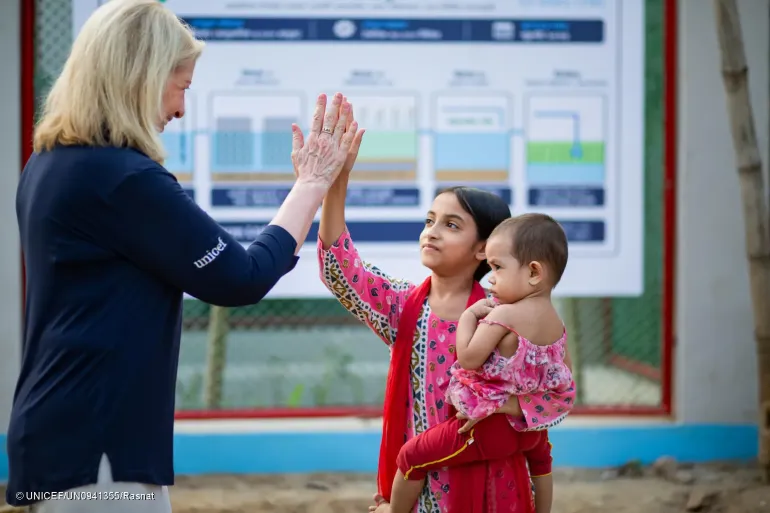
UNICEF Executive Director Catherine Russell has called for urgent investment in children in Bangladesh, urging stronger action to end child marriage, keep girls in school and protect education and essential services for Rohingya refugee and host-community children in Cox’s Bazar.

Russell made the appeal following a three-day visit to Bangladesh, during which she met children and families in Korail, one of Dhaka’s largest informal settlements, as well as Rohingya refugees and members of host communities in Cox’s Bazar.

The UNICEF chief highlighted three priorities: ending child marriage and keeping girls in education; fulfilling government commitments to increase investment in education and health; and safeguarding quality learning for Rohingya refugees and Bangladeshi host-community children.

Nearly half of young women married before 18

Child marriage remains a major concern in Bangladesh, with 47.2 percent of women aged between 20 and 24 having been married before reaching the age of 18, according to the Bangladesh Multiple Indicator Cluster Survey 2025 cited by UNICEF.

UNICEF warned that early marriage can force girls out of school, increase the risk of early pregnancy and sharply reduce their educational and economic opportunities later in life.

During a visit to Korail, Russell met children and parents who described poverty, interruptions to education and limited access to basic services.

Adolescent girls also spoke about their ambitions and the social and economic pressures that can lead girls to leave school and marry at an early age.

Russell highlighted the case of a 14-year-old girl named Bushra, whose early marriage was prevented following intervention by community leaders at a UNICEF-supported child protection hub.

“Keeping girls in school and providing them with the health, education and protection services they need will deliver on a brighter future for them, their communities and Bangladesh,” Russell said.

UNICEF has called for measures that enable girls to complete secondary education and for legal loopholes that can permit child marriage to be addressed.

UNICEF urges greater investment in education and health

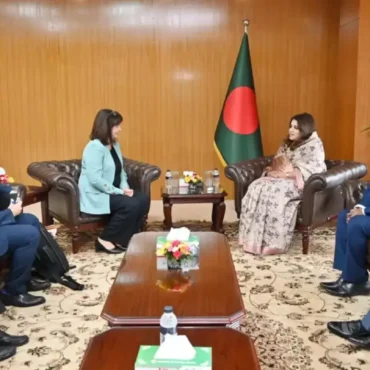
During her visit, Russell met senior Bangladeshi officials, including State Minister for Foreign Affairs Shama Obaed Islam.

She welcomed the government’s commitment to increase spending on education and health, while stressing that budget commitments need to translate into concrete services for children.

“Budgets reveal priorities,” Russell said. “Investing in children’s quality education, health, nutrition and protection is investing in Bangladesh’s future.”

UNICEF said stronger public investment is particularly important for children facing poverty, displacement and other forms of vulnerability.

Rohingya children ‘cannot lose their education too’

Russell also travelled to Cox’s Bazar, where Bangladesh hosts a large Rohingya refugee population displaced from Myanmar.

She met Rohingya children and families and visited UNICEF-supported learning activities in the refugee camps.

While acknowledging Bangladesh’s role in hosting Rohingya refugees, Russell appealed to international donors to maintain support for both the refugee population and Bangladeshi communities hosting them.

At a UNICEF-supported learning centre, she spoke with students and teachers about education and vocational skills.

UNICEF said education in the camps serves not only as a pathway to knowledge and skills but also as an important protection mechanism against exploitation, trafficking, child marriage and recruitment by armed groups.

“Rohingya children have lost so much to violence, displacement and uncertainty. They cannot lose their education too,” Russell said.

“The world must invest in them, and in the communities that welcomed them.”

Declining humanitarian funding threatens essential services

The appeal comes as humanitarian agencies face declining funding for the Rohingya refugee response in Bangladesh.

In Cox’s Bazar, UNICEF and its partners provide services including treatment and prevention of malnutrition, safe drinking water and sanitation, education, health care, child protection and psychosocial support for Rohingya children and families.

The agency also supports vulnerable members of surrounding Bangladeshi host communities.

UNICEF warned that sustained international assistance is increasingly important as humanitarian funding declines, saying reduced support could put essential services and previous humanitarian gains at risk.

Across Bangladesh, UNICEF works with government agencies and partner organisations on education, primary health care, immunisation, nutrition, water and sanitation, child protection and social protection programmes.

The agency also works on preventing child marriage and violence against children, supporting adolescent girls and advocating increased public investment in services for children.

For Rohingya children living through prolonged displacement in Cox’s Bazar, UNICEF stressed that continued access to education and other essential services remains critical while uncertainty over their future persists.

Tagged as: , , , , , , , , , , , , , , , , , , , , , , , , , , , , , , , , , , , , , , , , , .

Download now: Episode: KPN 27-10-2026

file_download Download

Rate it
Previous episode