

search menu
play_arrow

keyboard_arrow_right

skip_previous play_arrow skip_next
00:00 00:00
playlist_play chevron_left
volume_up
chevron_left
play_arrow

November 2026

Episode: KPN 15-11-2026

Kaladan Podcast November 15, 2026


Background
share close

Loading

Malaysia tightens refugee registration as Myanmar repatriation drive raises Rohingya protection concerns

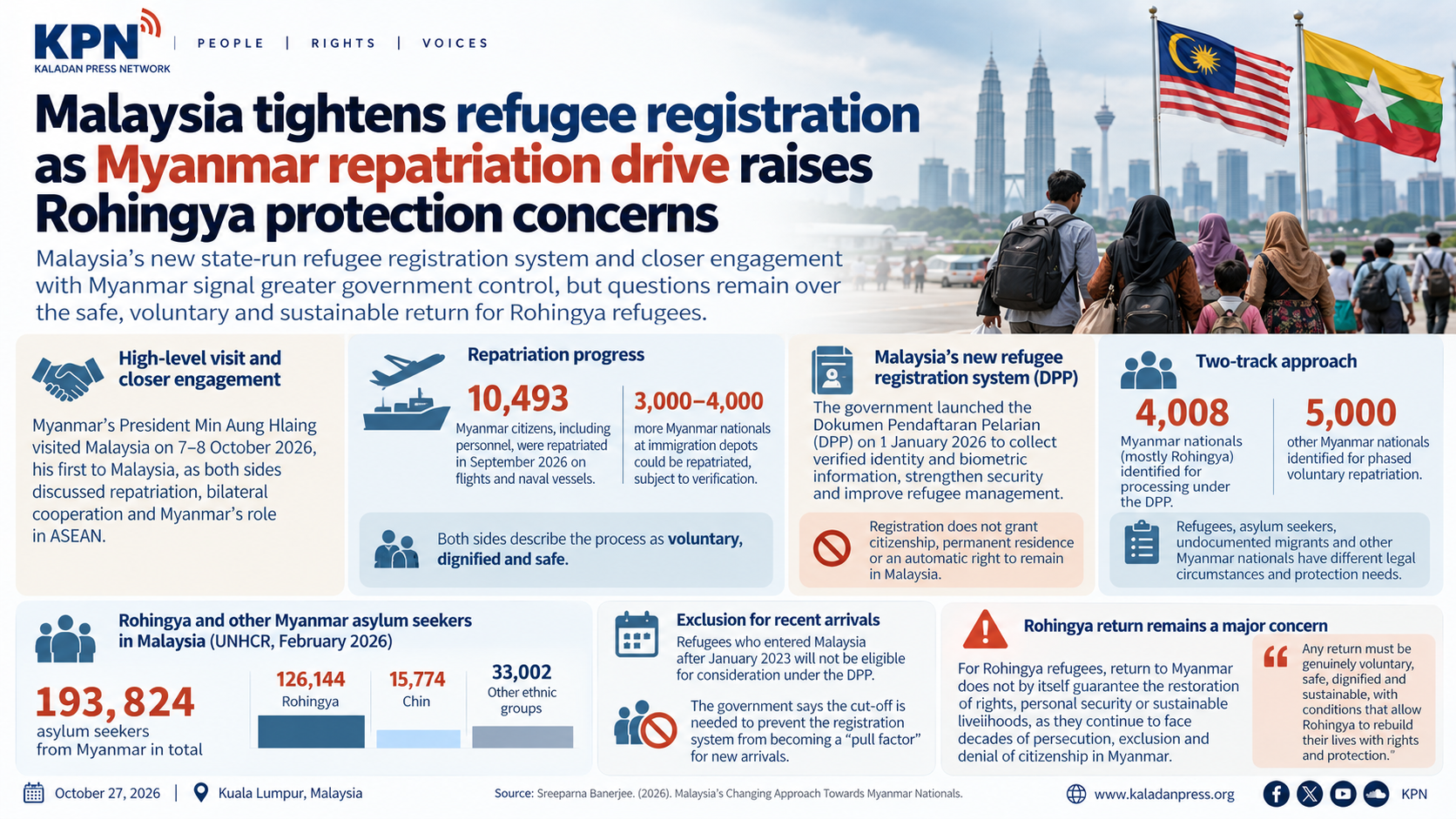
Malaysia is moving toward tighter state control over refugee registration while expanding direct cooperation with Myanmar on repatriation, a policy shift that could have significant implications for more than 126,000 Rohingya refugees and asylum seekers living in the country.

The changes come as Kuala Lumpur deepens engagement with Naypyidaw and develops its government-run Dokumen Pendaftaran Pelarian, or Refugee Registration Document (DPP), system to collect identity and biometric information and conduct immigration and security screening.

At the same time, Malaysia and Myanmar are expanding cooperation on the return of Myanmar nationals, bringing renewed attention to a critical distinction: returning Myanmar citizens through an immigration process is not the same as establishing conditions for the safe and sustainable repatriation of Rohingya refugees who have faced decades of exclusion, persecution and denial of citizenship in Myanmar.

Malaysia–Myanmar ties deepen amid repatriation push

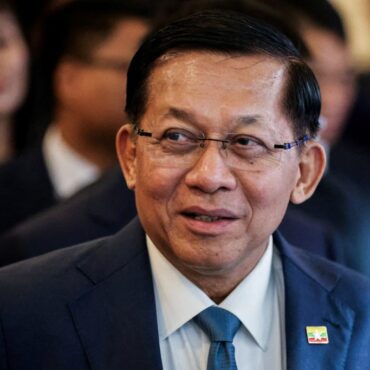
Myanmar President Min Aung Hlaing made a two-day official visit to Malaysia on October 7–8, during which the two governments discussed repatriation, bilateral cooperation and Myanmar’s relationship with the Association of Southeast Asian Nations (ASEAN).

According to the source analysis, the visit was Min Aung Hlaing’s first to Malaysia since becoming president in April.

Malaysia maintained that its engagement with Myanmar was intended to support peace, reconciliation and humanitarian access and did not constitute political endorsement of the military-backed government.

Repatriation emerged as one of the immediate issues.

Malaysia’s prime minister said 10,493 Myanmar citizens, including personnel, had been repatriated in September through flights and naval vessels.

The two countries’ home ministries were expected to negotiate further returns, while Min Aung Hlaing indicated that between 3,000 and 4,000 Myanmar nationals being held at immigration depots could be repatriated following verification of nationality, records and criminal history.

Both governments have described the process as voluntary, dignified and safe.

Malaysia introduces state-controlled refugee registration

Alongside its diplomatic engagement with Myanmar, Malaysia is implementing a major change in the way refugees are registered and managed.

The DPP was introduced through a pilot programme on January 1, 2026.

Malaysia’s Home Ministry says the government-run system is designed to collect verified identity and biometric information, improve refugee management, strengthen national security and support immigration enforcement.

Registration under the programme does not grant citizenship, permanent residence or an automatic right to remain in Malaysia.

The system represents a significant change from Malaysia’s previous approach, under which registration by the UN refugee agency, UNHCR, served as the principal mechanism for identifying refugees and asylum seekers.

Malaysian authorities are now seeking to establish their own refugee database using personal information, biometric registration, police screening and immigration checks.

The government planned to process around 6,000 refugees during the first phase, with the target increasing to 20,000 in 2027.

Post-January 2023 arrivals face exclusion from DPP consideration

The new registration programme is also becoming increasingly connected to Malaysia’s broader immigration policy.

Malaysia’s home minister said on October 13 that refugees who entered the country after January 2023 would not be eligible for consideration under the DPP.

The government argues that the cut-off is necessary to prevent the registration system from becoming a “pull factor” encouraging additional arrivals.

Authorities also intend to use information collected through the programme to determine the actual number of refugees living in Malaysia and guide future government policies.

The DPP and Malaysia’s repatriation policy had already begun operating along two separate tracks.

According to the source, 4,008 Myanmar nationals — mostly Rohingya — were identified for processing under the DPP, while another 5,000 Myanmar nationals were identified for phased voluntary repatriation.

The distinction is significant because refugees, asylum seekers, undocumented migrants and other Myanmar nationals have different legal circumstances and protection needs and cannot be treated as one group.

More than 126,000 Rohingya registered in Malaysia

UNHCR figures cited in the source show that Malaysia hosted approximately 193,824 asylum seekers from Myanmar as of February 2026.

They included 126,144 Rohingya, 15,774 Chin and 33,002 people belonging to other ethnic groups.

The figures underscore the importance of distinguishing Rohingya refugees from other Myanmar nationals when discussing repatriation.

On September 29, Malaysia returned 1,476 Myanmar nationals — 1,370 men, 79 women, 20 boys and seven girls — aboard three Myanmar vessels as part of an agreed programme covering up to 5,000 people.

Rohingya were not included in that category.

Rohingya return involves more than nationality verification

For Rohingya refugees, the central issue is not simply whether Myanmar authorities recognise them for the purpose of return.

Rohingya have faced decades of persecution, exclusion and denial of citizenship in Myanmar. Consequently, physical return to Myanmar does not by itself guarantee restoration of rights, personal security, freedom or sustainable livelihoods.

Any repatriation process therefore raises questions about whether conditions that originally forced Rohingya to flee have fundamentally changed.

The distinction between voluntary repatriation and administrative return is particularly important.

Malaysia has repeatedly said that repatriation should be voluntary, safe and dignified.

However, the source notes that UNHCR has not been involved in the repatriation process and has raised concerns over whether decisions to return can be independently assessed as genuinely voluntary and informed.

Refugee management increasingly tied to bilateral diplomacy

Malaysia’s changing approach points to a broader transformation in its refugee policy and relationship with Myanmar.

Refugee management is increasingly being connected to bilateral diplomacy, including direct discussions between Kuala Lumpur and Naypyidaw over identification, screening and repatriation.

Malaysia is also seeking greater government control over refugee governance through its own registration, biometric identification and security-screening system.

The government argues that this approach will produce more reliable information and improve policy planning while helping address national security and irregular migration concerns.

The result is a system in which humanitarian protection and immigration management increasingly operate within the same policy framework.

Closer Myanmar engagement creates diplomatic balancing act

Malaysia’s willingness to maintain direct engagement with Myanmar also comes as Naypyidaw seeks greater regional engagement.

According to the source analysis, Kuala Lumpur has expressed willingness to support Myanmar’s eventual reintegration into ASEAN while maintaining that engagement should contribute to peace, reconciliation and humanitarian access.

The approach could give Malaysia greater influence in regional discussions over Myanmar, humanitarian assistance and repatriation.

However, it also creates a difficult diplomatic balance between engagement with Naypyidaw and maintaining pressure for accountability and refugee protection.

Registration does not resolve Rohingya protection crisis

Malaysia’s new registration system could provide authorities with more accurate information about Rohingya and other refugee populations that have largely existed outside the country’s formal legal system.

But registration alone does not resolve the fundamental protection issues facing the Rohingya.

It does not restore Rohingya citizenship rights in Myanmar, guarantee protection from renewed persecution or establish conditions necessary for a safe and sustainable return.

Malaysia’s policy shift therefore brings together three increasingly interconnected developments: Myanmar’s efforts to rebuild regional engagement, Malaysia’s move toward greater state control over refugees, and expanding bilateral cooperation on repatriation.

For Rohingya refugees, the decisive measure will not simply be how many people can be returned.

The more fundamental question is whether any return is genuinely voluntary, safe and dignified and whether Rohingya can rebuild their lives sustainably with rights and protection in Myanmar.

Without those conditions, tighter registration and bilateral repatriation mechanisms may help governments manage displacement without resolving the insecurity and lack of rights that caused Rohingya to flee.

Source/Analysis: Based on “Malaysia’s Changing Approach Towards Myanmar Nationals,” by Sreeparna Banerjee, Associate Fellow with the Strategic Studies Programme, published October 26, 2026.

Tagged as: , , , , , , , , , , , , , , , , , , , , , , , , , , , , , , , , , , , , , , , , , .

Download now: Episode: KPN 15-11-2026

file_download Download

Rate it
Previous episode